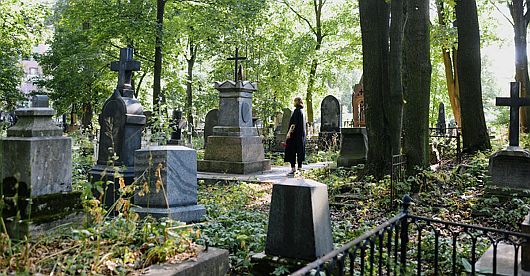
"Good Friday deserves our attention and death deserves our grief," says Belle Tindall-Riley.
"I recently scrolled past a short clip of JRR Tolkien suggesting that ‘human stories are practically always about one thing, aren’t they? Death. The inevitability of death.' He may be onto something."
"In her book A Place at the Table, A Rocha’s Jo Swinney movingly writes, ‘I think we know in our bones that we were made for permanence, which makes death an outrage, an offence, all but impossible to grasp’.
This article is from the London Institute for Contemporary Christianity section on Connecting with Culture.
"There are multiple ways in which humans seem to be endlessly responding to ‘knowing’ such a thing – the likes of Peter Thiel making significant investments in so called ‘immortality technology’ is one, governments pushing through death-controlling legislation is another. I, with the nudging of JRR Tolkien, have come to see storytelling as yet another.
"Death is a mystery we humans can’t help but try to solve, an enemy we attempt to wrestle to the ground, a circle we endeavour to square. It’s part of the human condition, I suppose, to ‘rage, rage against the dying of the light’, in the poet Dylan Thomas’s words, to seek a hope that can finally oppose death.
"Set against this cultural backdrop, we have a striking story to tell. Which is why it’s important that we don’t skip over today – Good Friday – when we tell it.
"With all our best intentions, we can brush over this part of the story, favouring a ‘Sunday’s coming’ kind of attitude. I get that. But Sunday is only the best day in human history because Friday was the worst. It deserves our attention. Death deserves our grief.
"Because it is an outrage. It is an offense. It is all but impossible to grasp.
"That’s why today matters. Because the death of Jesus is all those things, and then immeasurably more. To pretend otherwise is to undermine the utter wonder of Easter, isn’t it? To skirt over today, to not look it directly in the eye, to tell only half (the happy half) of the Easter story is to strip it of its glorious sense.
"Jesus’ death was not the end of his life; resurrection is the victory because death is the outrage. It’s struck me this year that to breeze past today, to rush people in the direction of Sunday, is to ignore the outrage and therefore somewhat sanitise the victory.
"If Tolkien is right, and all human stories are about ‘death. The inevitability of death’, we must tell this not-so-human story in its entirety. It is, after all, the only one that offers true hope."
Belle is Head of Culture at LICC and co-host of the Re-Enchanting Podcast
This article is from the London Institute for Contemporary Christianity section on Connecting with Culture.